
More Intelligent Than Previously Thought – Scientists Uncover Surprisingly
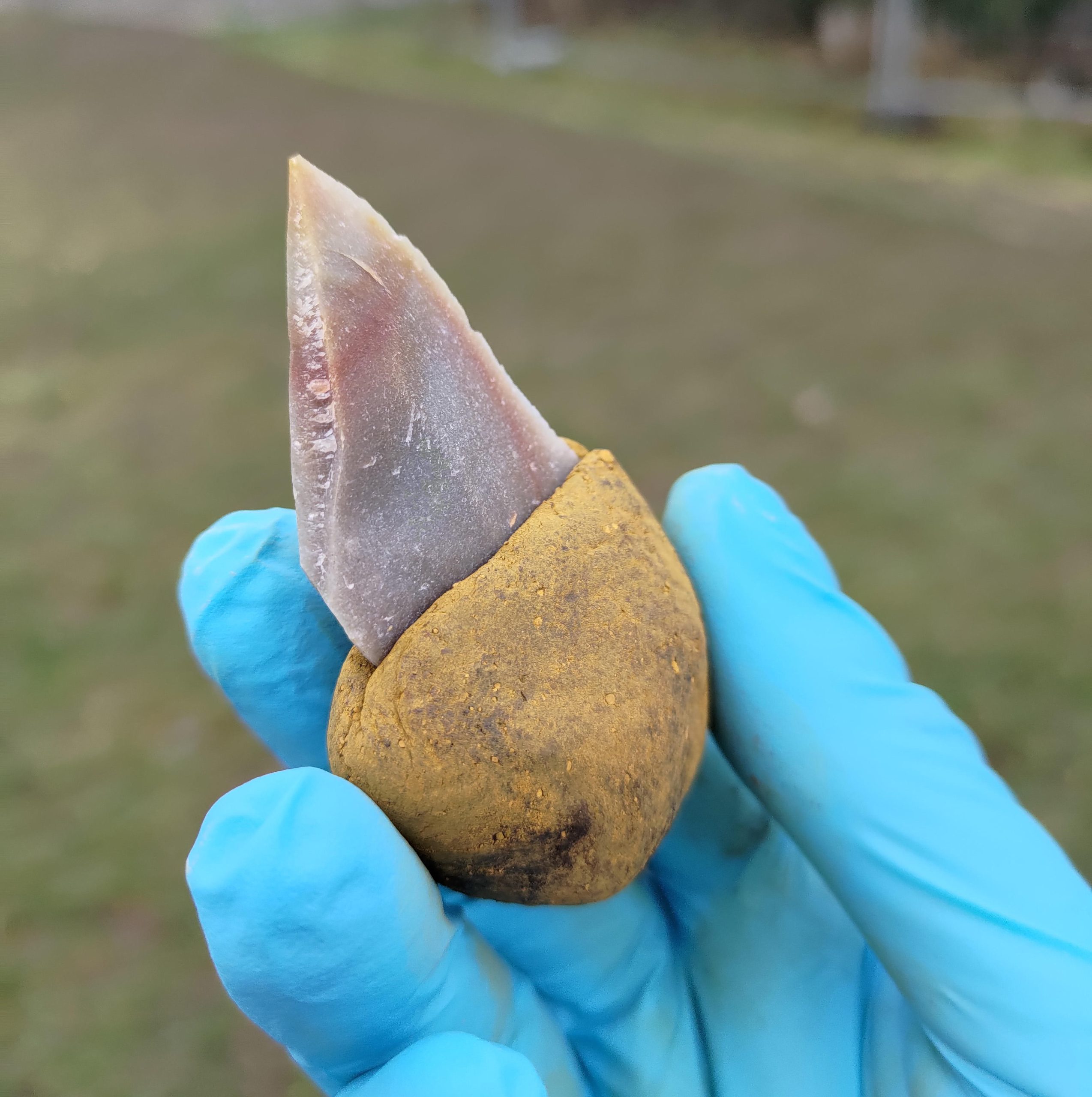
The stone tool was glued into a handle made of liquid bitumen with the addition of 55 percent ochre. It is no longer sticky and can be handled easily. Credit: Patrick Schmidt
Analysis of tools that are 40,000 years old has revealed a surprisingly sophisticated level of construction.
A team of researchers has found that Neanderthals crafted stone tools using a sophisticated multi-component glue. This discovery, the oldest known example of such an advanced adhesive in Europe, indicates that these early human relatives possessed a greater degree of intellectual and cultural sophistication than was earlier believed.
The work, reported in the journal New York University, the University of Tübingen, and the National Museums in Berlin.
Technical Innovations by Neanderthals
“These astonishingly well-preserved tools showcase a technical solution broadly similar to examples of tools made by early modern humans in Africa, but the exact recipe reflects a Neanderthal ‘spin,’ which is the production of grips for handheld tools,” says Radu Iovita, an associate professor at 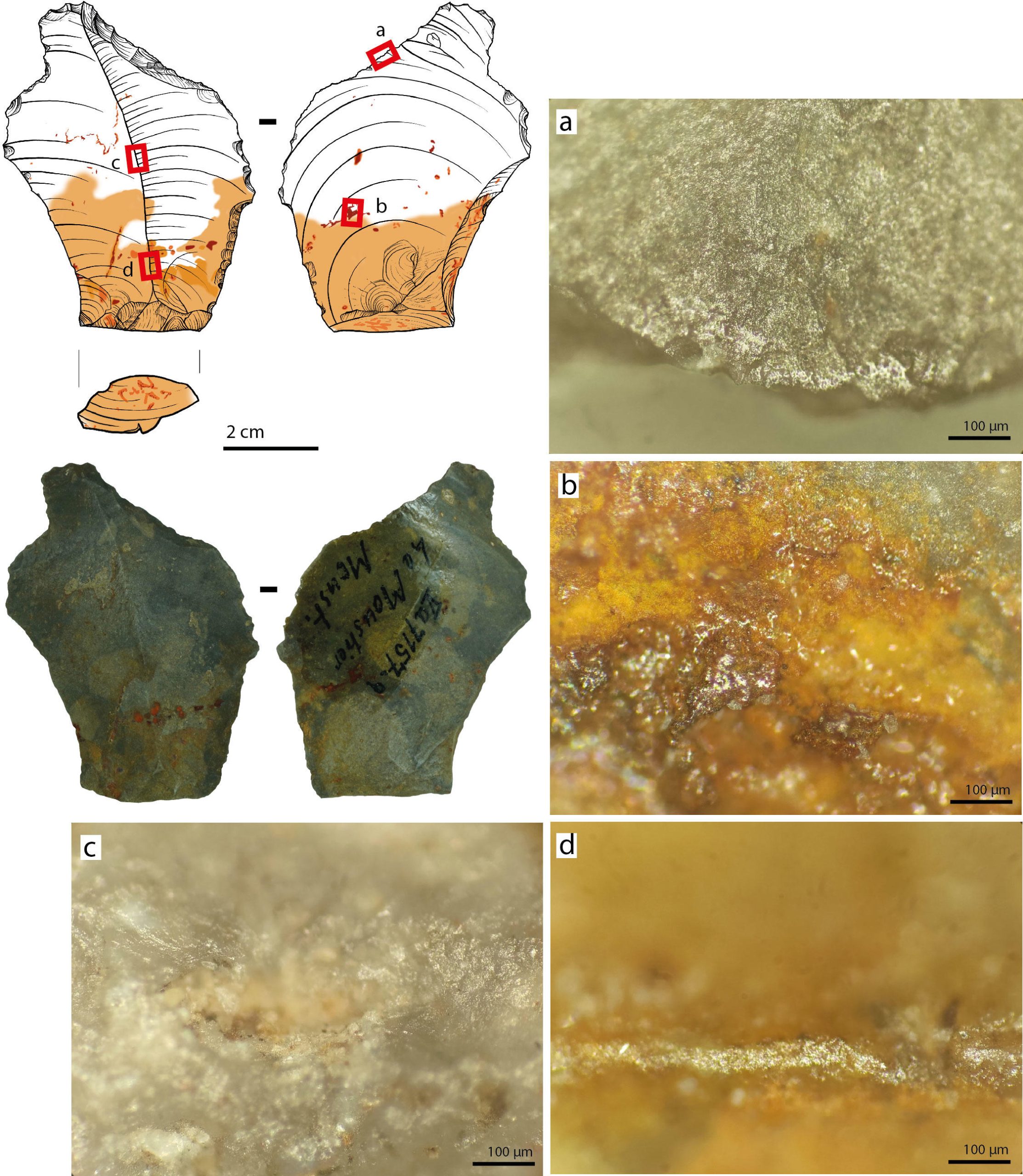
Micrographs showing wear traces on a tool used by Neanderthals during the Middle Palaeolithic period. Locations of the micrographs on the artifact are indicated in the drawing (upper left) in red. a) Polish, or sheen, on the active edge of the tool handle. b) Polish under colorant stains within the zone covered by adhesive. c) Ridge between concave surfaces formed by the removal of bits of stone that were removed—rather than worn away naturally. d) Dulled out or worn down ridge in the graspable zone that was covered with an adhesive. A comparison of (c) and (d) indicates that the worn-out portion is within the area covered by the designed adhesive grip. Images are shown in microns. Credit: Drawing by D. Greinert, Staatliche Museen zu Berlin
The stone tools from Le Moustier—used by Neanderthals during the Middle Palaeolithic period of the Mousterian between 120,000 and 40,000 years ago—are kept in the collection of Berlin’s Museum of Prehistory and Early History and had not previously been examined in detail. The tools were rediscovered during an internal review of the collection and their scientific value was recognized.
“The items had been individually wrapped and untouched since the 1960s,” says Dutkiewicz. “As a result, the adhering remains of organic substances were very well preserved.”
Uncovering Ancient Technologies
The researchers discovered traces of a mixture of ochre and bitumen on several stone tools, such as scrapers, flakes, and blades. Ochre is a naturally occurring earth pigment; bitumen is a component of asphalt and can be produced from crude oil, but also occurs naturally in the soil.
“We were surprised that the ochre content was more than 50 percent,” says Schmidt. “This is because air-dried bitumen can be used unaltered as an adhesive, but loses its adhesive properties when such large proportions of ochre are added.”
He and his team examined these materials in tensile tests—used to determine strength—and other measures.
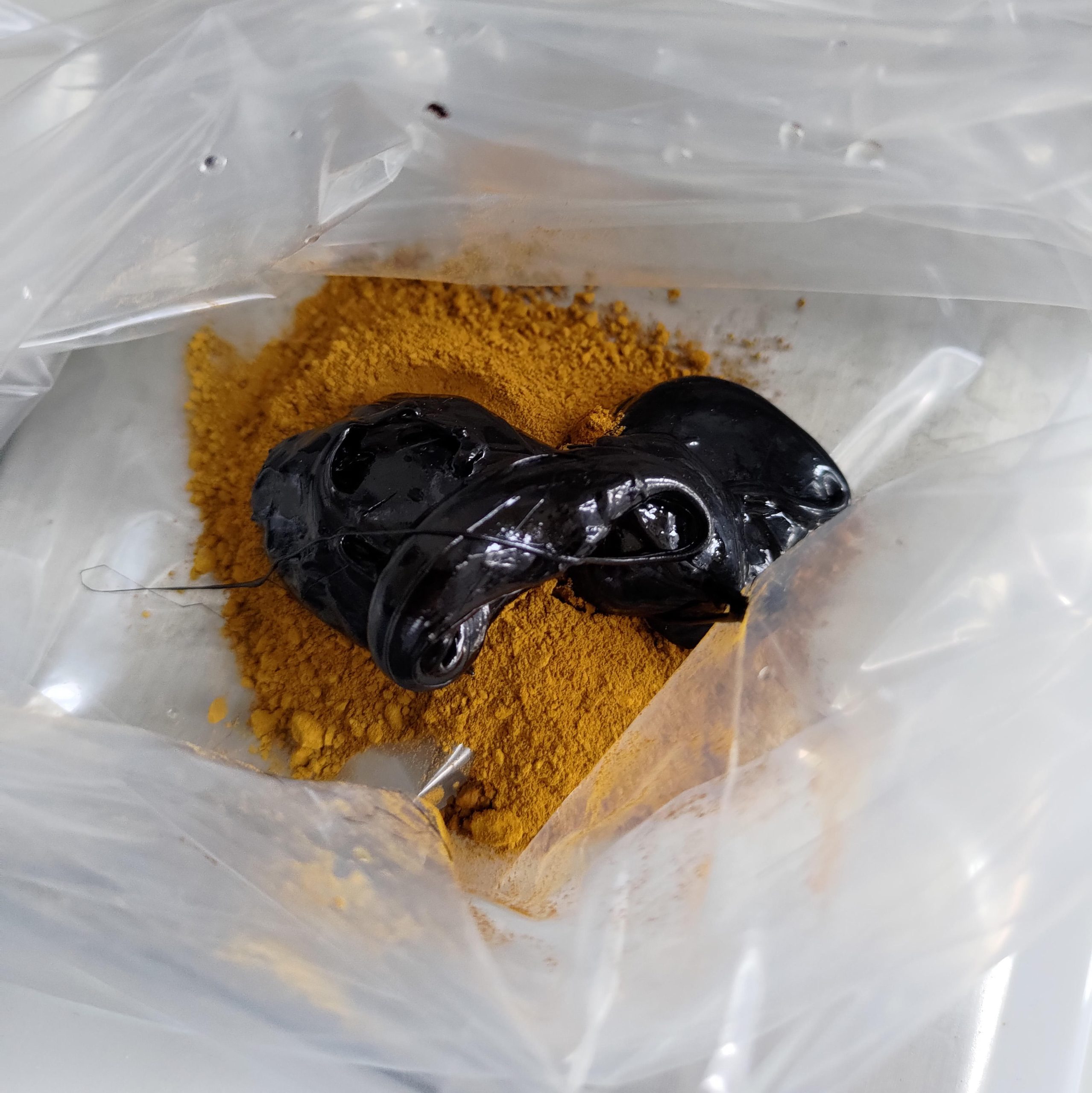
Liquid bitumen and the earth pigment ochre prior to mixing. Credit: Patrick Schmidt
“It was different when we used liquid bitumen, which is not really suitable for gluing. If 55 percent ochre is added, a malleable mass is formed,” Schmidt says.
The mixture was just sticky enough for a stone tool to remain stuck in it, but without adhering to hands, making it a suitable material for a handle.
Significance of the Findings
In fact, a microscopic examination of the use-wear traces on these stone tools revealed that the adhesives on the tools from Le Moustier were used in this way.
“The tools showed two kinds of microscopic wear: one is the typical polish on the sharp edges that are generally caused by working other materials,” explains Iovita, who conducted this…
Read More:More Intelligent Than Previously Thought – Scientists Uncover Surprisingly