
Sun Emits Monumental X6.3 Flare, the Strongest in 6 Years
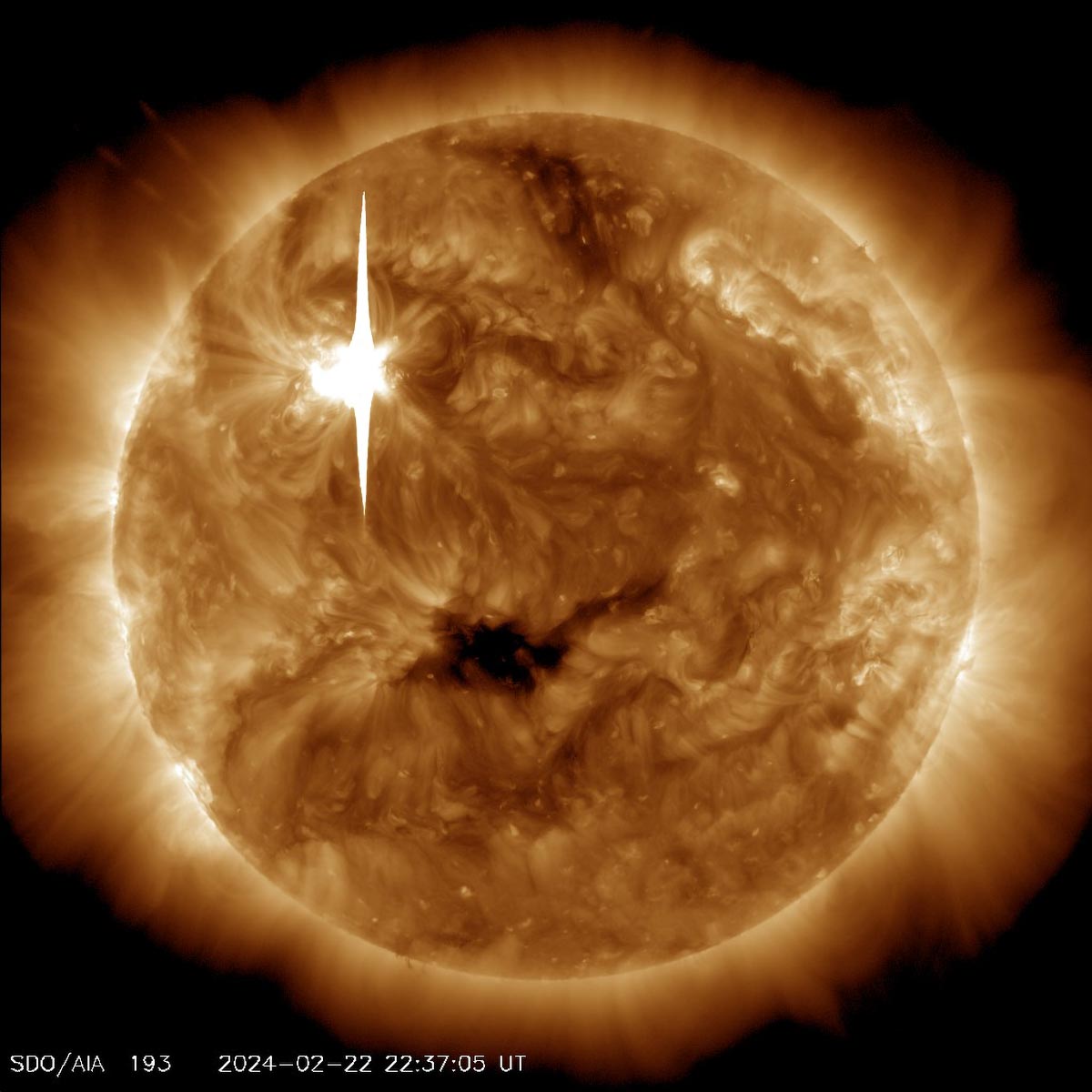
NASA’s Solar Dynamics Observatory captured this image of a solar flare – as seen in the bright flash in the upper left of the Sun – on February 22, 2024. The image shows a subset of extreme ultraviolet light that highlights the extremely hot material in flares and which is colorized in bronze. Credit: NASA/SDO
On February 22, 2024, the Sun emitted an extremely strong solar flare. It reached its peak at 5:34 p.m. 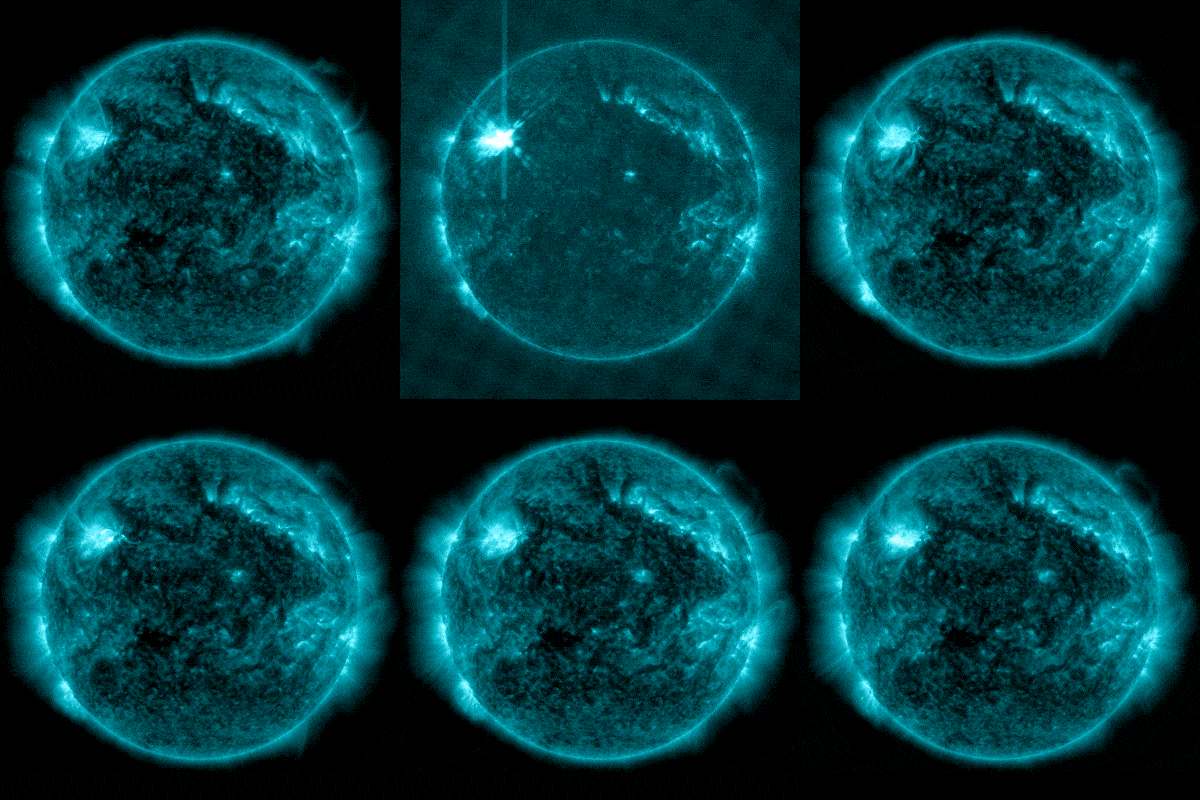
NASA’s Solar Dynamics Observatory captured these images of a solar flare – as seen in the bright flashes in the upper left area of the Sun – on February 21 and 22, 2024. The images show a subset of extreme ultraviolet light that highlights the extremely hot material in flares and which is colorized in teal. Credit: NASA/SDO
That X6.3 flare was the third significant solar flare within 24 hours. Earlier the Sun emitted two strong solar flares, the first one, classified as an X1.8 flare, peaked at 6:07 p.m. EST on February 21, 2024. The second one, classified as an X1.7 flare, peaked at 1:32 a.m. EST on February 22, 2024.
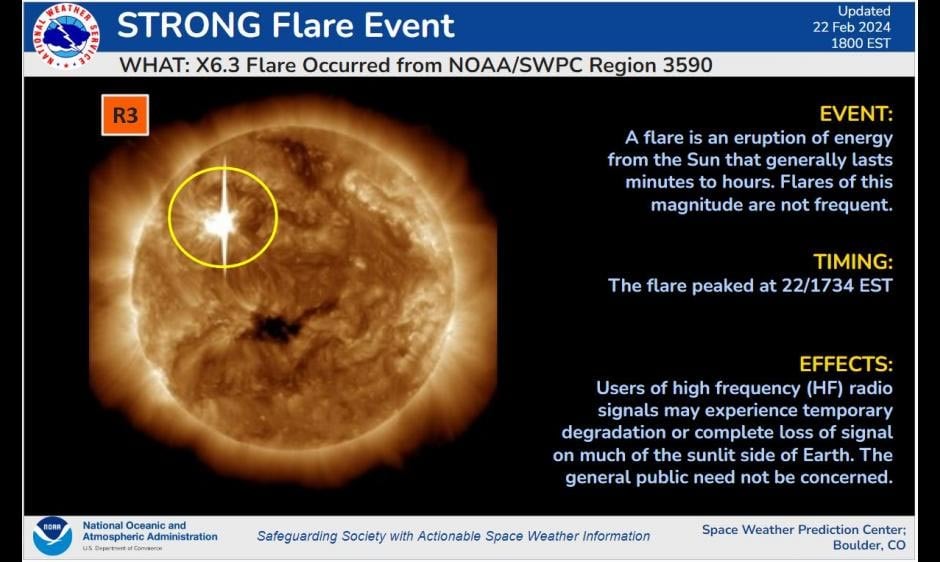
Another X-class flare from Region 3590 peaked at approximately 1734 EST on February 22, 2024. The X6.3 flare was the largest of the three X-class flares that occurred in the past 24 hours, and the strongest of this solar cycle. While impressive, this event still poses no significant threat to the general public. Credit: NOAA
NASA’s Solar Dynamics Observatory
NASA’s Solar Dynamics Observatory (SDO), which captured the images on this page, was launched in February 2010. Its mission is designed to observe the Sun and its solar activities comprehensively. Positioned in a geosynchronous orbit about 22,000 miles above Earth, SDO provides unparalleled insights into solar phenomena, including solar flares, sunspots, and coronal mass ejections (CMEs).
SDO’s primary goal is to understand the Sun’s influence on Earth and near-Earth space by studying the solar atmosphere in many wavelengths simultaneously. It is equipped with a suite of instruments that allow scientists to monitor the Sun’s magnetic field, its surface, and atmospheric activities in high resolution. One of the key instruments, the Atmospheric Imaging Assembly (AIA), captures images of the solar atmosphere in 10 different wavelengths every 12 seconds, providing a dynamic view of the Sun’s behavior. Through its continuous observation, SDO plays a critical role in improving our ability to forecast space weather events that can affect life and technology on Earth.
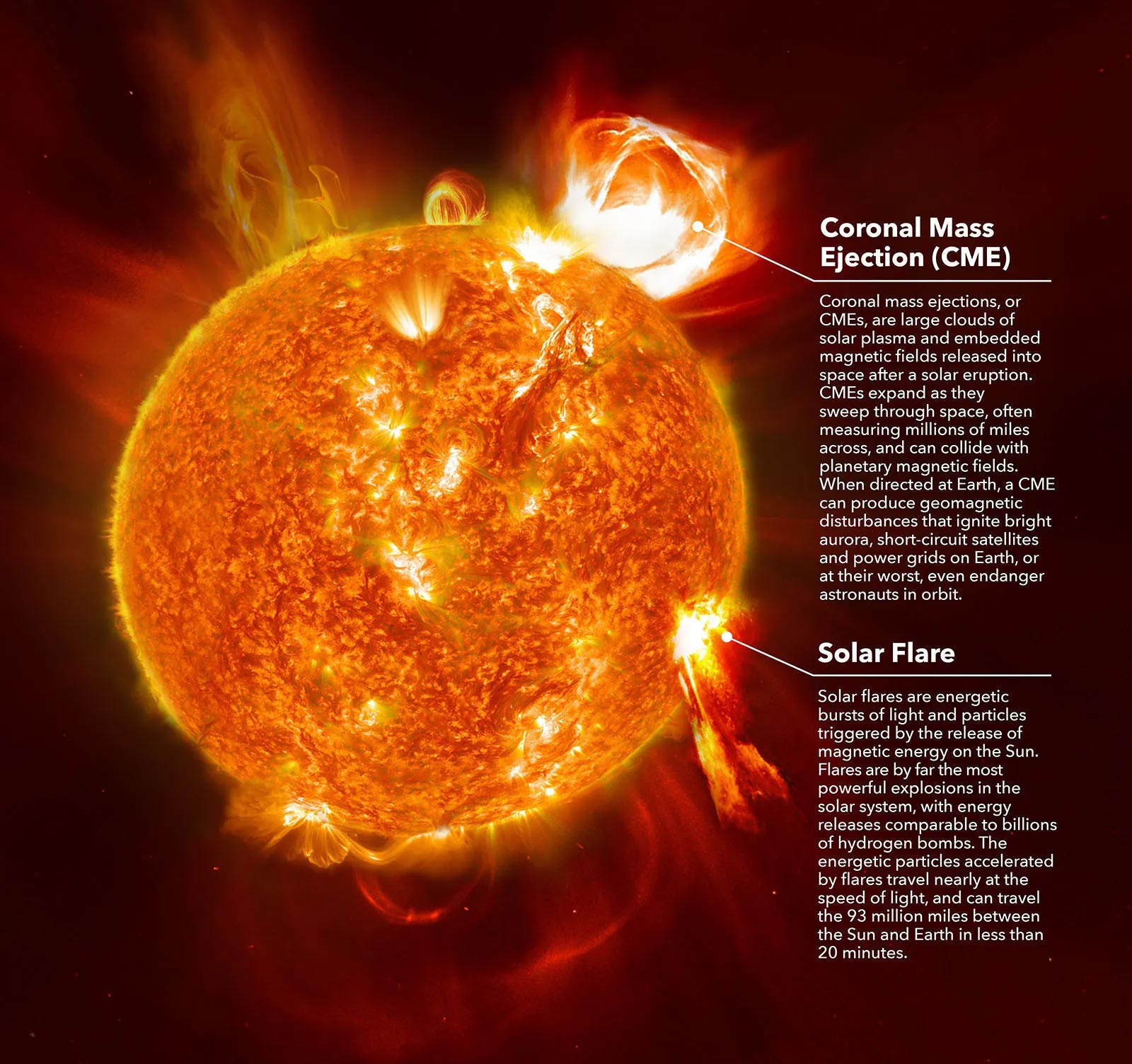
Coronal mass ejections and solar flares. Credit: NASA’s Goddard Space Flight Center/Mary Pat Hrybyk-Keith
Solar Flares
Solar flares are intense bursts of radiation that originate from the release of magnetic energy on the Sun’s surface. These energetic phenomena can emit light across the entire electromagnetic spectrum — from radio waves to gamma rays. The energy released by a solar flare can be monumental, rivaling billions of megatons of TNT in terms of explosive power.
The classification of solar flares is based on their brightness in X-ray wavelengths, as observed by satellites orbiting Earth….
Read More:Sun Emits Monumental X6.3 Flare, the Strongest in 6 Years